

Workflow Assessment and Automation Strategy
Designing an AI-informed, automation-ready workflow model to reduce manual effort, improve operational clarity, and support compliance readiness.

Project Overview
A Multi-State Behavioral Health Organization engaged me to assess a labor-intensive post-discharge follow-up workflow and identify opportunities to reduce manual effort through AI and automation.
The engagement focused on understanding the current process, isolating inefficiencies, and designing a future-state workflow that could improve operational clarity, reduce administrative burden, and support compliance requirements.
My Contributions
I led the engagement independently as a consultant, guiding the process from initial consultation through workflow analysis and strategic recommendation.
My role focused on:
- Facilitating discovery and stakeholder conversations
- Translating AI concepts into practical, relevant use cases
- Documenting and analyzing the existing workflow
- Designing a future-state operational model
- Delivering a clear, client-facing implementation proposal
Client:
A Multi-State Behavioral Health Organization
Engagement Type:
Workflow assessment and automation strategy
Role:
Solo Consultant
Timelne:
Short consulting engagement
Status:
Assessment completed, implementation proposed but not initiated
The Challenge
The organization’s follow-up operations relied heavily on manual coordination and spreadsheet tracking. Staff were responsible for managing outreach, logging attempts, tracking responses, and maintaining documentation across multiple systems.
This created a workflow that was:
- Time-intensive and repetitive
- Dependent on manual data entry
- Fragmented across tools and systems
- Difficult to track and manage consistently
In addition, the team had limited exposure to AI and automation, making it difficult to identify practical opportunities for improvement.
Approach
I structured the engagement to move from understanding and education into workflow analysis and solution design.
1. Initial Consultation
I began with a one-hour consultation to understand the organization’s current state, discuss their challenges, and introduce a practical framework for evaluating AI opportunities within their workflows.
2. On-Site Discovery
I met with the team in person to expand on foundational AI concepts and explore how those ideas could apply to their operations. During this session, we identified post-discharge follow-up as a high-impact workflow to assess.
3. Workflow Walkthrough
I conducted a detailed walkthrough with a staff member responsible for the process, capturing each step from intake through follow-up completion. The session was recorded and transcribed to ensure accuracy.
4. Workflow Analysis and Design
Using the documented workflow, I identified inefficiencies, redundant steps, and opportunities for automation. I then designed a future-state model that reorganized the process into a more structured and scalable system.
5. Client-Facing Deliverable
The final output was a structured presentation that translated the findings into a clear operational model, supported by workflow diagrams and a phased implementation blueprint.
What I Found
The primary issue was not a single breakdown in the process, but a lack of system cohesion.
The workflow depended on staff manually managing and transferring information between systems, including the EMR, spreadsheets, and forms. This created unnecessary duplication, increased the risk of errors, and made it difficult to maintain visibility across the process.
Key Insight
The organization did not need a faster version of the same workflow. It needed a clearer operating model with defined system roles, reduced manual handoffs, and a structured approach to automation.
Recommended Future-State Workflow
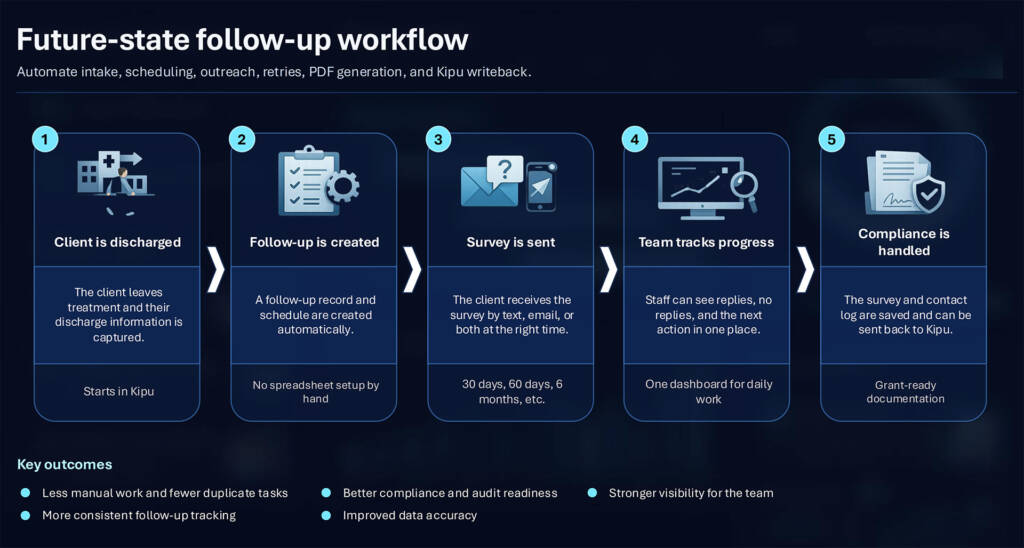
The proposed solution introduced a more connected workflow designed to centralize operations and reduce manual coordination.
Core Flow
- Client discharge is captured in the EMR
- Automation intake creates a structured event
- A follow-up record and schedule are created automatically
- Survey outreach is sent via SMS, email, or both
- Responses are captured through forms
- Documentation is generated for compliance use
- Retry logic handles non-responses
- Completion data is written back to the EMR
This model replaces spreadsheet-based tracking with a more structured system that supports consistency, visibility, and scalability.
System Architecture
The recommendation defined clear system responsibilities to reduce duplication and improve data flow:
- Kipu (EMR): Source of clinical data and final record
- Automation Layer (Zapier, Make, or n8n): Orchestrates workflow events and data movement
- CRM / Operations Platform: Manages follow-up tasks, schedules, and dashboards
- Forms and PDFs: Capture responses and generate compliance-ready documentation
This separation of concerns allows each system to perform a specific role while remaining connected through automation.
Value of the Assessment
Although the workflow was not implemented during this engagement, the assessment provided clear strategic value by transforming a loosely managed process into a defined operational model.
The engagement:
- Clarified the workflow from end to end
- Identified where manual effort could be reduced or removed
- Highlighted opportunities for automation and system integration
- Created alignment around how the process should function
Provided a practical foundation for future implementation
Deliverables
The final deliverable was a client-ready presentation designed to support decision-making and future investment.
It included:
- Workflow assessment findings
- Future-state workflow diagram
- Operating model and system architecture
- 4-week implementation blueprint
- Immediate decision framework for next steps
Proposed Implementation Approach
Rather than jumping directly into development, the recommendation outlined a phased approach to reduce risk and ensure alignment.
Phase 1 — Discovery and Validation
- Confirm integration capabilities with the EMR
- Validate business rules and compliance requirements
- Review existing data structures and inputs
Phase 2 — Solution Design
- Define the data model
- Map fields across systems
- Design automation logic and workflow states
Phase 3 — Build First Release
- Configure the operations platform
- Connect automation workflows
- Generate documentation outputs
- Test initial recordsç
- Run the new workflow alongside the current process
- Validate outputs and resolve edge cases
- Train staff and prepare for transition
Outcome
This engagement resulted in a clear, implementation-ready workflow strategy. While the client did not move forward with the build at this time, the work established a structured foundation for how their follow-up operations could be redesigned to reduce manual effort, improve visibility, and support compliance.
What This Project Demonstrates
This project reflects my approach to combining workflow analysis, UX thinking, and practical AI strategy.
Rather than focusing on tools alone, I work to understand how people, processes, and systems interact, then design solutions that bring clarity, structure, and scalability to those workflows.